|
Jewish
Memorial Traditions and Customs
The
Ritual of K'riah (TEARING OF A RIBBON OR GARMENT)
Those
closest to the deceased may perform this ritual.
Son,
Daughter, Spouse, Sister, Brother,
Life
Partner,
Mother,
Father.
For
a son or daughter of a deceased, the ribbon is worn on the left side
of the clothing (as the left side is closer to the heart and the
loss of a parent is considered to be the most profound loss).
For other relatives, the ribbon is
worn on the right side.
Those
who choose to perform K'riah gather privately just prior to the
funeral service. While standing, they recite a prayer with the
rabbi, who then makes a small cut in their ribbons (or garments).
Other
people who were in a close relationship with the deceased may also
choose to wear and cut the K’riah ribbon. These include
gay/lesbian partners, in-laws, nieces and nephews, grandchildren and
divorced spouses.
Shivah
(Mourning period)
A
period of mourning observed after the funeral or memorial service
for a maximum of seven days, during which the mourners remain at
home, refraining from work, social and leisure activities. The
mourners are visited by family members and friends, who provide
meals, comfort and companionship. Some synagogues provide religious
services in the house of mourning.
RITUAL
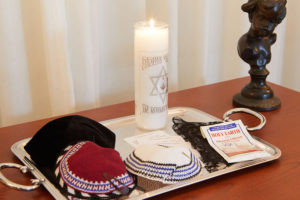
ITEMS PROVIDED BY THE CHAPEL
-
Yarmulkes-in
black
-
Veils-in
black
-
K’riah
ribbons
-
Benches/boxes-for
use during shivah
-
Memorial
candles-for use by the family during shivah
-
Kaddish
cards-for use by family and friends at the burial or memorial
service. The Kaddish will be provided by the chapel in its
original language and in transliteration.
PRIOR
TO THE FUNERAL:
Chevra
Kaddishah (Holy Society)
Group
of trained people who prepare a body for burial; men prepare men's
bodies, women prepare women's bodies.
Taharah
(Purification)
Washing
of a body before burial as a ritual act of purification.
Tachrichim
(Shrouds)
Simple
cotton or linen shrouds used by some Jews for burial.
Sh'mirah
(Watching), Shomer (Guard)
The
act of attending the body of a deceased from death until the funeral
begins.
AT
THE TIME OF THE FUNERAL:
Yarmulke
(Skull cap)
Also
called a kippah. This is a small cap worn as a sign of respect at a
funeral or in a holy place.
Veil
A
small lace head covering worn by some women as a sign of respect at
a funeral or in a holy place.
K’riah
(Tearing)
The
tearing or cutting of a garment or small black ribbon as a sign of
mourning (see "The Ritual of K’riah").
Kaddish
(Prayer recited in memory of the deceased) "See
below"
This
prayer is recited at the time of burial, or in the case of a
memorial service, in the chapel.
El
Maley Rachamim (God Full of Compassion)
A
passage asking for God's compassion and the peaceful rest of the
deceased. At a chapel service, this is usually the last prayer
recited by the rabbi, and is customarily recited while the
congregation stands.
AFTER
THE FUNERAL:
Shivah
(Mourning period)
A
period of mourning observed after the funeral or memorial service
for a maximum of seven days, during which the mourners remain at
home, refraining from work, social and leisure activities. The
mourners are visited by family members and friends, who provide
meals, comfort and companionship. Some synagogues provide religious
services in the house of mourning.
Benches/Boxes
To
symbolize that their spirits are low, many Jewish mourners choose to
sit on low benches or boxes during shivah.
Memorial
Candle
The
candle is a reminder of the deceased as well as the presence of God.
The memorial candle usually burns continuously for about seven days.
Monument
(Stone)
A
permanent marker indicating the location of a grave, usually at the
head or foot of the grave. Some family plots are marked by a single
stone with the name(s) of the family, while other graves are marked
with individual names, including Hebrew names, dates of birth and
death, familial relationships and sometimes a phrase of remembrance.
Unveiling
A
ceremony in which the monument is displayed publicly for the first
time. Many Jews assume the unveiling should be on the first
anniversary of death, but it may actually take place any time after
shivah. In the New York area, most families choose to hold
unveilings during May, June, September and October, when the good
weather makes it easier to get to the cemetery.
Click
the folowing links for Prayer Kaddish and for Jewish
holidays.
|